
Nix files
shell-lsp is a language server for Nix and for everything written inside Nix strings. This page is the full reference; the README has examples, and corpus.md records how the answers compare with nixd and nil. The Nix checks are listed in rules.md.
- Which strings are shell
- Languages written from Nix
- How a string becomes a script
- Variables the Nix around a script sets
- The shell and the Nix answer for each other
- Strings passed to a wrapper in another file
- The Nix language
- Rename
- Everything else
- What cannot be checked
Which strings are shell
A document is a Nix file when it ends in .nix, whatever language identifier the editor gives it, or else when its language identifier is nix. A string literal there is shell, with no marker needed, when it stands in one of these places. The table of them was read from the option declarations of a pinned nixpkgs and home-manager, and an attribute counts wherever it is written: as one long path, as nested sets, inside flake.modules.x.y, home-manager.users.x or any other prefix, and through a function such as lib.mapAttrs.
- Derivations: a phase or hook (
buildPhase,installPhase,preConfigure,postInstalland the otherpre/posthooks,buildCommand), ashellHook, the script ofrunCommand,runCommandLocal,runCommandCC,runCommandNoCC,runCommandNoCCLocalandrunCommandWith. - Writers:
writeShellScript,writeShellScriptBin,writeShellApplication(text),writeBash,writeBashBin(also with their options),writeDashandwriteDashBin(asdash), andwriteScriptandwriteScriptBin, which run what their shebang names. - Images and environments:
runAsRootandextraCommandsofdockerTools.buildImage,extraCommandsandfakeRootCommandsofbuildLayeredImageandstreamLayeredImage, andrunScript,profile,extraBuildCommands,extraInstallCommandsandextraPreBwrapCmdsofbuildFHSEnv. - Units:
script,preStart,postStart,preStop,postStopandreloadofsystemd.services.*andsystemd.user.services.*, also underboot.initrd. TheExec*strings ofserviceConfigand home-manager'sService, also in a list, are command lines with their-,+,@,:and!prefixes dropped. - NixOS:
system.activationScripts.*andsystem.userActivationScripts.*, as a string or.text,environment.shellInit,loginShellInit,interactiveShellInit,extraInitandshellAliases.*,programs.bash.*Init,logoutandshellAliases.*,programs.zsh.*InitandshellAliases.*(as zsh),boot.initrd.pre*Commandsandpost*Commands(as BusyBox),boot.postBootCommands,extraInstallCommandsof the boot loaders,networking.localCommands,firewall.extraCommandsandextraStopCommands,nat.extraCommandsandextraStopCommands,dhcpcd.runHook, the hooks ofnetworking.wireguard.interfaces.*andnetworking.wg-quick.interfaces.*,powerManagement.*Commandsandservices.xserver.displayManager.sessionCommandsandsetupCommands. - home-manager:
home.activation.*,home.extraProfileCommands,home.extraBuilderCommands,home.sessionVariablesExtra,home.shellAliases.*,onChangeof the files below,programs.bash.bashrcExtra,initExtra,profileExtraandlogoutExtra,programs.zsh.initContent,initExtra,initExtraFirst,initExtraBeforeCompInit,completionInit,envExtra,profileExtra,loginExtra,logoutExtra,shellGlobalAliases.*andsiteFunctions.*(as zsh), and a value ofprograms.git.settings.aliasorprograms.git.aliasesthat starts with!. - Named files: the text of
writeText,writeTextDir,builtins.toFile,writeTextFile,home.file.*,xdg.configFile.*,xdg.dataFile.*,xdg.stateFile.*andenvironment.etc.*, when its shebang names a shell, or else when its file name does (.sh,.bash,.zsh,.dash,.ksh, a shell's rc file). The name isdestination, thentarget, then the attribute or argument that names the file. - By hand: a
/* bash */(orsh,dash,zsh,ksh,shell) comment right before it. - Through a function in the same file: static following shows it hands the string to one of the above: its formal is the
textofwriteShellApplication, the script argument of a writer or ofrunCommand, a phase of a derivation, a${text}on a line of its own in a shell string, or the argument after-cthere, also throughlib.escapeShellArg, through further functions and through an alias of a writer. Such a function may also writewriteTextFilewith a shell's shebang.
Strings known to be in another language are not read as shell: writeFish, writeNu, writePython3, writePyPy2, writePyPy3, writePerl, writeRuby, writeLua, writeJS, writeRust, writeHaskell, writeNim, writeGuile, writeBabashka, writeFSharp, writeRscript and writeCBin, testScript of a NixOS test (Python), programs.fish.*, programs.nushell.* and services.udev.extraRules. A ${name} of such a writer still hovers with the head of what it writes, in that language. security.wrappers and makeSetupHook take paths, so they hold no string to read, and only the writer behind them counts.
Languages written from Nix
A string in a named file whose name is that of a justfile, Makefile or Dockerfile gets everything those languages have in a file of their own, at its place in the .nix file: the syntax errors and checks of the language (SL5, SL6 and SL7) including names that are never used, Hadolint's DL rules with its # hadolint pragmas and .hadolint.yaml, the shell in its recipes and RUN lines with all its linting, highlighting and navigation in the shell the file decides, semantic tokens, completion, signature help, and definition, references and hover for its recipes, targets and variables. ${...} stands for text no one can know, and a finding that touches one is dropped. Hover and rename answer as that language does: a rename edits every read in the string and is refused when one would write into a ${...}. Findings offer the fixes they have in a file of their own, written back with the string's escapes; edits that would together empty the shallowest lines of an indented string, and so re-indent the rest, are withheld, and fixes that would do so only together stay out of fix-all. The same goes for such a file written by a string named x.nix, at any depth. An include or import in such a file resolves to another file written from the same place in Nix (home.file."x/justfile" and home.file."x/lib.just"). What it does not find is reported for a file in the store (writeText and the like), where nothing can stand beside it, and not for a file placed in the home directory or /etc, where a real file may.
A string in a named file whose name ends in .nix is Nix: its syntax errors and checks, semantic tokens, and definition, references and hover for its bindings answer inside the string, with the shell strings it holds read as anywhere else. It is not followed across files, its names are not renamed, and a finding that touches a ${...} is dropped. Its refactorings are offered too, titled with the file they apply to, and written back through the string.
How a string becomes a script
The binding counts through lib.optionalString, lib.mkIf, mkBefore, mkAfter, mkForce, mkDefault, mkOverride, mkOrder, lib.hm.dag.entryAfter, entryBefore, entryBetween, entryAnywhere, lib.stringAfter, noDepEntry, fullDepEntry, if ... then ... else and or, the items of lib.mkMerge, concatStringsSep, concatStrings and concatLines, the bodies of concatMapStrings, concatMapStringsSep, map and mapAttrsToList, and the strings joined with + in one binding are one script, so an if may open in one and close in another.
An antiquotation in a shell string is read for what it is:
A string it holds is shell in that place:
${lib.optionalString c "..."},${if c then "..." else ""}, the items ofconcatStringsSep,concatStringsandconcatLines, and the bodies ofconcatMapStrings,concatMapStringsSep,mapandmapAttrsToList. Of anifwith text in both branches the first is read. Inside shell single quotes it stays one word.A shell writer in it (
${writeShellScript "x" ''...''}) is read as a script of its own that the outer one runs, as$(...).As a command word,
${pkg}/bin/fooand${lib.getExe' pkg "foo"}are the programfoo, and${lib.getExe pkgs.foo}isfooor themainProgramof well-known packages (gnusedissed,ripgrepisrg), also behindsudo,envand the other wrappers. Every check, hover and embeddedjq,awkorsedprogram treats it as that command. Its name is not edited, since the antiquotation decides it.lib.escapeShellArg,toStringand the program getters lead to what they read.Anything else stands for text the shell cannot know, so nothing is reported about the placeholder itself. With
enable=unescaped-antiquotations,SL8014reports one inside a command's argument whose value is not provably safe.Strings sourced into a session (shell init, aliases,
shellHook, activation entries) and strings marked only by a/* zsh */comment keep what they define for later, and a sourced path is not followed.$outand the other builder variables whose values cannot hold a space, and the variables Home Manager gives an activation entry, count as safe to leave unquoted.Indentation is removed as Nix removes it,
''',''$and''\x(or\",\$and the other escapes of a"string) are what Nix makes of them, and every other${...}stands for text the shell cannot know. Fixes are escaped for the string they land in, and new lines get its indentation.A phase runs as stdenv runs it: inside a function, with
set -eu -o pipefail, in the same shell as the other phases, and with every attribute of the derivation and of its setup hooks in the environment, so reading a variable the phase never sets is not reported (SC2154). The same goes for ashellHookand for a script with a non-emptyenvironment,runtimeEnvor wrapperenv. The scripts of the writers and of systemd units otherwise run on their own, andwriteShellApplicationadds its strict mode and honours itsexcludeShellChecks.Each string is checked as the shell its place decides: phases, the bash writers, units and activation scripts are bash,
writeDashis dash, zsh options are zsh, and a file or shebang says for itself. A string read into a shell someone else set up, such as an init option or alias, does not report variables it never sets or reads (SC2154,SC2034).
Variables the Nix around a script sets
Inside the shell, a variable that the Nix around it puts in the environment leads to the attribute that sets it, with definition, references, document highlight and hover showing the binding and where it comes from. These are:
- in a phase or
shellHook, the attributes of its derivation, alsoinherited ones (where definition goes on to what theinheritreads) and those underenv, but notmeta,passthruor__-prefixed ones, so$pnameand''${version}reachpname = ...;andversion = ...;. A set merged with//or anenvthat is a value from another file counts too; $xPathfor a namexinpassAsFile, which leads tox, and a name after--setinmakeWrapperArgs, whose hover says that it reaches the wrapped program and not the phases;- in a
runCommandscript, the attributes it is given; - in a systemd unit's scripts, its
environment, also spelled as one long path; - in a
writeShellApplication'stext, itsruntimeEnv; - in a wrapper's string, the keys of the argument that wrapper passes on as the environment, so
env.xreaches$x; - when nothing nearer sets it,
home.sessionVariables,environment.variablesandenvironment.sessionVariablesof the project's modules, of any class.
In a phase, $out, $src, $pname, $version, $name, $system, $builder, $stdenv, $srcs, $outputs, $prefix, $sourceRoot, $phases, $curPhase, $NIX_BUILD_TOP, $NIX_BUILD_CORES, $NIX_STORE, $NIX_LOG_FD, $TMPDIR, $TMP, $TEMP, $TEMPDIR, $HOME, $PATH, $PWD, $SHELL, $CONFIG_SHELL, $SOURCE_DATE_EPOCH and $TZ are known to come from the builder or setup.sh: hover says so unless an attribute sets them, and they are never reported.
An attribute that sets a variable is not renamed, from the shell or from itself, since other Nix code may read it by its name.
The shell and the Nix answer for each other
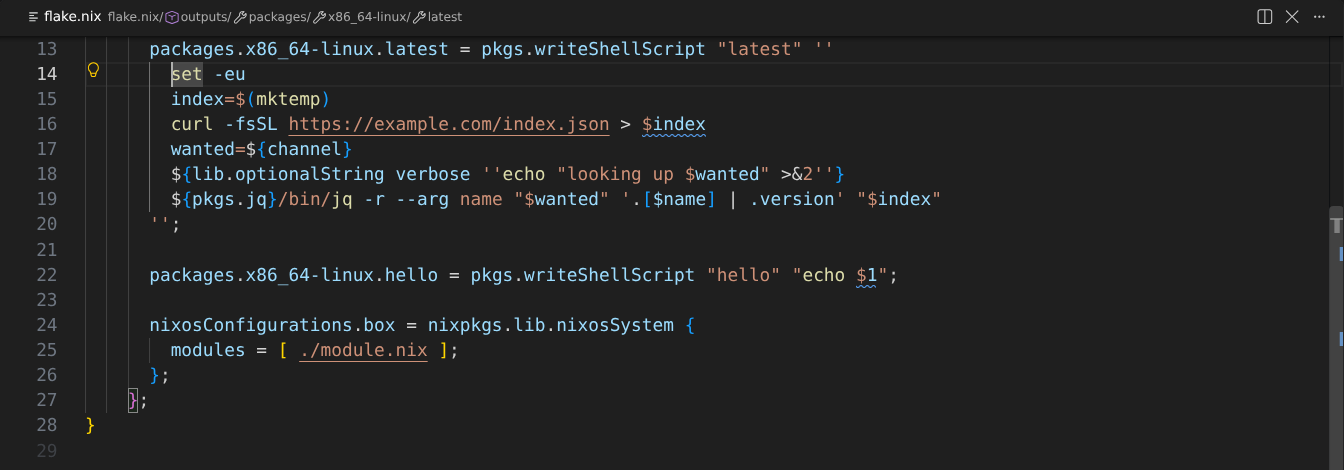
The shell and the Nix around it answer for each other:
${...}in a shell string is Nix: every feature of the Nix language answers inside it.- A
$namein a jq or awk program follows its flag:jq --arg name "$value" '$name'andawk -v name="$value" '...'lead from the variable to the flag, on to the shell variable, an assignmentvalue=${x}and the Nix binding or attribute behind it, also in another file. Definition lists each of them, references hold them all and hover shows the chain, in a plain shell script too. Renaming$namerenames the flag and the reads in that program and leaves the rest, which keep their own names; it is refused when the program also reads$ARGSor when an antiquotation or escape splits the name. - A command word
${pkg}/bin/foo,${lib.getExe pkg}or${pkg}is that program. On the shell text next to the antiquotation, hover says what it runs, and definition goes to the binding ofpkgwhenpkgis a name bound in the project. Definition on the name itself in${pkgs.jq}reads the locked nixpkgs. - A name bound to
writeShellScript,writeShellApplication, the other writers or a wrapper is a command where it is interpolated. Definition and references reach it, hover shows the first lines of the script, and call hierarchy crosses the link. Its caller is the script that holds the string. - A name bound to
writeText,writeTextFile,builtins.toFileor a writer of another language is a file whose content is known: hover on${cfg}shows the head of what it writes, also when that is an expression such asbuiltins.toJSON { ... }. - A command in
text, a phase or a unit that matches an item ofruntimeInputs,buildInputs,nativeBuildInputs,packagesorpathleads to that item, or to the script the item names. - The phases of one derivation share a shell, so an assignment,
exportor function reaches later phases in the ordersetup.shruns them:shellHook, thenpre, the phase andpostof unpack, patch, configure, build, check, install, fixup, installCheck and dist. Definition, references and rename follow it. A read before the phase that sets it, or in another derivation, leads nowhere and hover says why. - In a shell string,
nix build .#xand the other uses ofnixwith a.#word lead toxof the flake that holds the file, looked up directly and underpackages,legacyPackages,apps,checks,devShells,nixosConfigurationsandhomeConfigurations. This assumes that the command runs in that flake.nix-shell -p xleads toxwhere one of the project's overlays sets it; anything else in nixpkgs leads nowhere. - A here-document inside a shell string is Nix when its delimiter is
NIX,nixorEOF_NIX, when# nixfollows it on its line, or when its line names a file ending in.nix. Its syntax errors are reported and its bindings navigate, but are not renamed. A body with${...}or an escape in it is left as text, since only evaluating it would show the Nix, and so is a Nix expression given tonix eval --expr.
Strings passed to a wrapper in another file
A string passed to a wrapper defined in another file is proven by following the project, and a keystroke never does that. Navigation, hover, references and call hierarchy answer in it as soon as a request reads the project. Its shell is linted and highlighted once a background pass has proven it: that pass follows the project from each open Nix file that has such a call, one at a time, after 750 ms without a change to an open Nix file or after a watched file or a setting changes, then asks the client to refresh diagnostics and tokens if the proven strings moved. Until then the string reads as plain Nix, and a diagnostics or tokens request on its own builds nothing. Between passes a proven string follows edits around it and inside it, and one whose opening was edited stops being shell until the next pass. These strings report syntax errors and shell findings, explained on hover and fixed by quick fixes and fix-all like any others. Workspace diagnostics and shell-lsp check prove them for closed files too. SC2154 stays off in a string the wrapper splices into a larger script, or runs with an environment of its own (a derivation, runCommand, a runtimeEnv or one the caller passes), since what it can read is not known there, and reports reads never set in a string that is the whole script.
The Nix language
Outside the shell, the Nix language answers too, within a file and across a project:
Syntax errors and checks are reported, as they are in every Nix file.
Definition, references, document highlight, hover and rename work for every binding:
let,recattributes, lambda arguments, formals,@aliases andinherit, also through${...}in a string. A cursor oninherit xmeans thexit reads.An attribute of a set is followed where the file itself proves it: through
s.a.b,s ? a,inherit (s) aandwith s;whensis bound in the file to an attribute set written there, and through the@alias of a function for its formals.Across files, the project is the nearest
flake.nixwith everything it reaches, plus the files that import the one at hand. Nothing is evaluated; what follows is read from the source:import ./x,import ./dir(itsdefault.nix),callPackage ./x { },pkgs.callPackage,lib.callPackageWithandimports = [ ./x ], also with the path in aletof the file. Definition on the path opens the file,(import ./x).areachesa, and the keys of a call reach the formals of the file it calls.- In a flake,
inputs.x, theoutputsformalx, an@alias and the string offollowsare all the declaration of the inputx, andself.yreaches the outputy. Whereflake.locklocks the input and its source is in the Nix store, definition also opens itsflake.nixordefault.nix, and reads such asinputs.x.lib.yandinputs'.x.packages.ygo on into the files there, up to 256 of them; nothing is downloaded, and nothing in the store is renamed. "${inputs.x}/y.nix","${./dir}/y.nix"and./dir + "/y.nix"are paths,~/xis one below the home directory, andimport ./xopens a filexwithout an extension before it triesx/default.nix.pkgsand thefinalandprevof an overlay read what the project's overlays set:final: prev:functions under an attribute namedoverlays, such asflake.overlays.xandnixpkgs.overlays. Sopkgs.x.yfollowslib.mapAttrs,lib.fix,makeExtensibleandlib.extend. Every overlay counts for everypkgsof the project, since which of them apply is only known by evaluating.- Modules are found from
mkFlake,nixosSystem,homeManagerConfiguration,darwinSystem,nixOnDroidConfiguration,evalModules,imports,nixosModules-style outputs,perSystem,withSystem,moduleWithSystem,home-manager.users.<name>,home-manager.sharedModules,flake.modules.<class>.<name>andimport-tree, which takes every.nixfile below a directory unless its path below that directory has a segment starting with_. Modules of one class share one namespace:options.a,config.aand a plainaare the same name, so a read ofconfig.aleads to every declaration and definition of it in every file._module.args.a,specialArgsandextraSpecialArgsmakeathe same name as the formalaof the modules of that class, whose definition is the binding. The options of atypes.submoduleandsubmoduleWith, also underattrsOf,lazyAttrsOf,listOfandnullOr, and the names an option set gets frommapAttrs, are names below their option. A file in two classes joins them for the names it holds, so a rename reaches both. - A set built with
//holds both sides, the right one first, when both are known.
Nothing else is guessed.
pkgs.hellothat no overlay sets is read from the locked nixpkgs source (below), and leads nowhere when there is noflake.lockor its nixpkgs is not in the store. The namespaces of two flakes never meet.The outline holds attribute sets,
letblocks and functions with their parameters, nested as they are written, with the shell's functions inside the binding that holds them; workspace symbols list every attribute andletbinding.Folding covers attribute sets, lists,
letblocks, strings, lambdas and runs of comments, and selection ranges grow from the shell in a string through the Nix around it.
Rename
A rename refuses, with the reason and the place, to rename to anything but a plain name, or when another binding would capture a read of the new name or be shadowed by it. Where other files or the module system read the name, the message lists those reads as file:line, so you can change them by hand and rename after. It also refuses names the evaluator itself reads, such as __overrides and the body of a legacy let, and an attribute of a non-recursive set unless every read of that set is proven, since anything else could read it by its name. What it does:
inherit xstays an attribute namedx: renaming the binding it reads writesx = new;, and renaming a binding made byinherit xwritesnew = x;, also taking it out of aninheritwith several names.- A formal is part of the function's interface. Renaming one also renames its reads through the
@alias and the keys passed at calls of that function, in this file and in the files that reach it byimportorcallPackage. It is refused for a formal of acallPackagetarget that some caller leaves forcallPackageto fill by name, and for a formal of a module or ofoutputs, which are passed by name, unless it is an input or a_module.argsname the project binds itself. - A
recattribute is renamed with its reads in the project. - An attribute of the value of a file is renamed with its reads when every
importof the file selects from it directly or through aletthat is only selected from. - An option is renamed everywhere in its class when the project declares it, or a set above it, in
options, and no read passes a set above it on as a value or selects from one with a computed name. Options declared elsewhere, such asservices.nginx.enableandflake, keep their names. - An input is renamed with its declaration, formals, reads and
follows, unlessinputsis read with a computed name.flake.lockfollows on the nextnix flake lock. - A project of more than 4096 files or 8 MiB of source is not followed past that, and a workspace scan stops at 20000 files. Following also stops at 32 levels of a set that holds itself, at 32768 attribute paths of modules, after 2^24 steps and after 8 rounds that still find something new. In each of these cases a rename that has to know every reader is refused with the reason.
Everything else
Diagnostics stay within the file, so typing never walks the project; it is read when a request needs another file, and only files that changed are parsed again.
Beyond that, Nix files get these:
The lints of statix and the findings of deadnix, as
SL8xxxchecks with fixes, a neareststatix.tomland# deadnix: skipcomments honoured, and further checks for Nix pitfalls; see the check list.Inlay hints name the parameter of a positional argument and the file a directory path opens, links open paths and web addresses, and call hierarchy follows functions across files.
Completion, hover and signature help cover the builtins, keywords, bindings, attributes and paths the file can see.
A "▶" lens on a flake output runs
nix build,nix runornix flake check. A dev shell needs a terminal: a client with the experimental capabilityshellLsp.runsInTerminal, such as the VS Code extension, gets a "▶ nix develop" lens whose client-side commandshellLsp.runInTerminalreceives{name, argv, cwd}; any other client gets "▶ Build dev shell", which proves the shell builds withnix develop --command true.Without evaluating anything,
lib.xis read from the source of the locked nixpkgs: hover shows its documentation, definition goes to it and completion lists the library. Names read throughwithgo to thatwith, and references list that name through it.config.x.and option keys complete from every file of the project, andinputs.from the flake.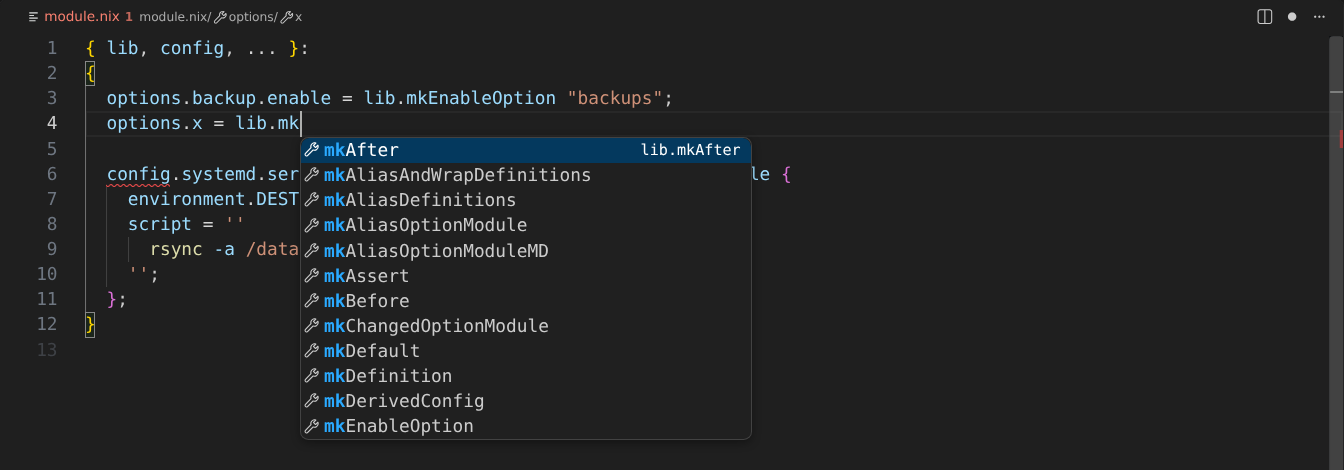
Without an evaluator, definition and hover read
pkgs.xfrom the locked nixpkgs source, or from the checkout when the file is inside nixpkgs, andlib.xthe same way, looking throughlib.mapAttrsand into whatmakeExtensibleadds, aslib.extend. Completion inwith lib.licenses;offers its names.finalAttrsinmkDerivation (finalAttrs: { ... })is the set it returns, for definition, hover, references and completion. So is the argument offixandmakeExtensible.Completion in the argument of
mkDerivation,mkShell,writeShellApplicationandwriteTextFile, and in a derivation'smeta, offers the keys they take.In a phase, the commands
stdenvand its setup hooks bring in, such aswrapProgram,makeWrapper,substituteInPlaceandpatchShebangs, answer hover, completion, signature help and their flags, and definition goes to the input that brings them in. A function of the same name in the script wins.Separate scripts do not share variables: definition, references, rename, hover and completion stay in the script the cursor is in, and
phasesof one derivation meet in the order they run.Shell checks read each script alone as well, so one script does not hide
SC2034orSC2154in another. The phases of one derivation and the pieces of one module option count as one script, and what a sourced surface or anoverrideAttrsphase assigns or reads stays visible to every script in the file.Type definition on an option goes to the
typeitsmkOptiongives.With
nix.evaluate, definition followspkgs.xtometa.position, or to where the attribute is bound when there is none or it is not a package (pkgs.runCommand),lib.xto that same position when the source of the library cannot follow it, and an option to its declaration, fetching the file first when it is not on disk, and option completion finds the class of a module passed through adeferredModuleoption. Nix evaluation requires Nix 2.24 or newer, Lix 2.95 or newer, or Determinate Nix based on Nix 2.24 or newer.Hover on a flake input shows its locked revision and date, and the code action "Update input x" runs
nix flake update x.The refactorings are extract to a
letbinding, inline aletbinding, spellx = x;asinherit x;and aninheritas bindings, rewrite a string between its quoted and indented forms when its value stays the same, quote or unquote an attribute, nest or flatten an attribute path, convert awithwhose names only it can answer tolet inherit, and extract a binding to a new file beside this one when its value reads nothing through awithand its name can spell a path. The file is offered only if it does not exist and the client can create files, and takes the names the value reads from this file as arguments.finalAttrsreads the set its function returns in any builder, andx.offers what this file reads through the samexwhen nothing else knows whatxholds.A flake input completes its keys, such as
followsandurl.pkgs.xfollows an alias inpkgs/top-level/aliases.nixto the package it names.An undefined name offers "Change to" the closest name in scope, and "Add to the arguments of this function" for the nearest function with a pattern.
url = "github:o/r"in a flake links to the page of that repository, also forgitlab:andsourcehut:.Typing
;formats the binding it ends, in editors that have format on type on.Each finding offers "Ignore here" and "Ignore in this file" fixes, a malformed
disablelist reportsSC1125, and withenable=unused-directivesa directive that suppresses nothing reportsSL2009.
What cannot be checked
Shell that Nix assembles across ${...}, such as a case whose patterns come from lib.optionalString, cannot be checked, since only evaluating the Nix code would show it, and may be reported as a syntax error.